
Is Stabilized Turquoise Worth It? A Buyer's Guide
Table of Contents
- Is Stabilized Turquoise Worth It? The Short Answer
- What Stabilization Actually Does to the Stone
- Natural vs Stabilized Turquoise: Key Differences
- Is Stabilized Turquoise Real? Separating Fact From Fiction
- How to Identify Stabilized Turquoise Before You Buy
- Stabilized Turquoise Price: What You're Actually Paying For
- Durability and Everyday Wear: Does Stabilized Turquoise Hold Up?
- Caring for Stabilized Turquoise Jewelry Long-Term
- Conclusion: When Stabilized Turquoise Makes Sense
- Frequently Asked Questions
Last Updated: October 16, 2026
Is Stabilized Turquoise Worth It? The Short Answer
Yes, stabilized turquoise is worth it for most everyday jewelry, provided you know what you are buying and pay accordingly.
Stabilized turquoise is natural turquoise that has been treated with a resin or polymer to harden the stone and hold its color. The turquoise itself is real.
That distinction matters because the market treats these two categories very differently. According to the Gemological Institute of America's treatment guidance, turquoise is one of the most commonly treated gemstones sold today, and stabilization is considered an accepted, permanent treatment rather than a deceptive one.
Below, we break down what stabilization does, how to spot it, what to pay, and when natural turquoise is the better call.
What Stabilization Actually Does to the Stone
Stabilization is a resin-impregnation process. Raw turquoise is porous, and lower-grade material can crumble under normal handling. The rough is placed under vacuum so resin penetrates the pores, then cured.
The result is a harder, more stable stone that holds its shape and color through daily wear. Durango Silver's explanation of stabilized turquoise notes that turquoise is stabilized to improve durability and preserve color, not to deceive buyers.
What stabilization does not do:
- It does not change the stone into a different material
- It does not create color that was not there (that is dyeing, a separate treatment)
- It does not restore value that soft, low-grade rough never had
Natural vs Stabilized Turquoise: Key Differences
Natural turquoise is untreated rough hard enough to cut and polish on its own. Stabilized turquoise is the same mineral, hardened with resin to survive everyday wear. The gap comes down to rarity, price, and behavior over time. Natural turquoise hard enough to cut untreated is scarce; much of what is mined is too soft to use untreated, which is why stabilization became standard practice and natural stones command higher prices.
| Factor | Natural Turquoise | Stabilized Turquoise |
|---|---|---|
| Durability | Varies by stone; can be fragile | Hardened, holds up to daily wear |
| Color stability | Can shift over time | Color held by resin |
| Rarity | Genuinely scarce at jewelry grade | Widely available |
| Price | Higher | Lower |
| Care needs | More careful handling | More forgiving |
| Best for | Collectors, occasional wear | Everyday jewelry |
Color, Matrix, and Appearance
Color and matrix trip up most buyers. High-grade natural turquoise often shows a tight, even matrix and deep, saturated blue or green. Stabilized stones can look just as striking, and resin sometimes deepens color slightly.
Matrix is not a quality signal on its own. A heavy, dark spiderweb matrix can indicate a harder stone, or signal that the rough was soft and needed stabilization.
Is Stabilized Turquoise Real? Separating Fact From Fiction
Stabilized turquoise is real turquoise, genuine mineral, treated by an accepted industry practice. Imitation turquoise is different material entirely, often dyed howlite, plastic, or reconstituted stone dust pressed with resin.
The confusion comes from lumping three categories together:
- Stabilized turquoise: real turquoise, hardened with resin
- Reconstituted turquoise: turquoise dust and resin pressed into blocks
- Imitation turquoise: non-turquoise material dyed to look like turquoise
Only the first is what most sellers mean by "stabilized." If a listing uses the word loosely, ask whether the stone is solid natural turquoise that has been treated, or a block made from dust.
How to Identify Stabilized Turquoise Before You Buy
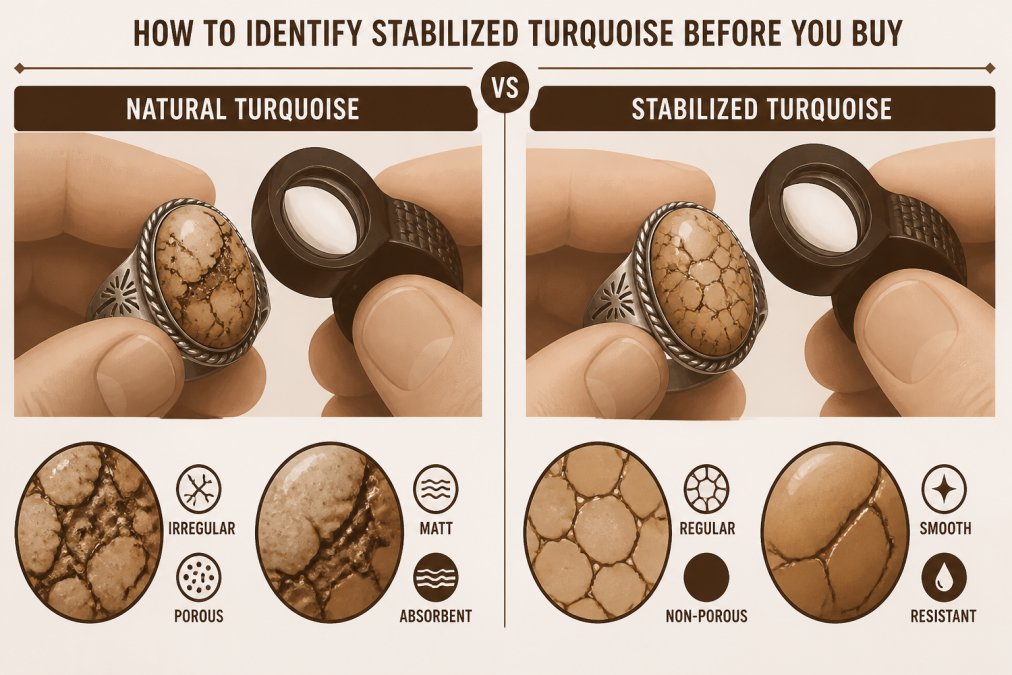
Identifying stabilized turquoise takes a few simple checks, none requiring a lab. But visual identification alone cannot reliably separate stabilized from natural turquoise, nor detect dye on top of stabilization.
Visual Cues (Useful, Not Conclusive)
Start with the surface under bright, direct light:
- Sheen. Stabilized stones often show a slightly waxy or plastic-like luster. Natural stones tend to look drier and more matte. Polishing affects this too, so treat it as a hint, not proof.
- Color uniformity. Suspiciously even, saturated color across a large stone can suggest dye on top of stabilization. Natural turquoise usually shows some variation.
- Matrix behavior. A matrix that looks painted on, or that sits only on the surface, is a warning sign. Natural matrix runs through the stone.
No cue is definitive alone. Two or three together, plus a seller who will not answer questions, is a strong signal to walk away.
Weight and Feel
Stabilized turquoise can feel slightly lighter than a dense natural stone of the same size, because resin is less dense than the mineral it replaces in the pores. The difference is subtle, so use it as a comparison tool, hold a known natural stone next to the one you are considering, not a standalone test.
The Buyer's Checklist: What to Ask and What to Get in Writing
Before you pay, get clear answers to these questions, ideally in the listing text or an email you can keep:
- Is this stone natural turquoise, stabilized turquoise, reconstituted turquoise, or imitation? The seller should use one of these words, not a vague phrase like 'genuine turquoise.'
- Has any dye or color treatment been added on top of stabilization? Stabilization and dyeing are separate treatments, and sellers sometimes combine them.
- Is the treatment permanent, or will it break down with heat, solvents, or age? Most modern resin stabilization is considered permanent under normal wear, but you should hear the seller say so.
- What is the origin of the rough, mine, region, or at least country? Origin is not proof of quality, but a seller who knows it is a seller who knows the stone.
- Is the setting solid sterling silver, gold, or plated? Plated settings wear through and change the long-term value of the piece.
- What is the return policy? A short, no-questions return window is the best protection against misrepresentation. If a seller will not offer one, treat that as information.
What Documentation to Look For
- A written description on the receipt or listing that names the treatment. 'Stabilized turquoise' on the paperwork is worth more than a verbal assurance.
- A grading or appraisal document for higher-priced pieces. Independent appraisals are common for pieces above the mid-hundreds of dollars.
- A named maker or studio. Signed, traceable work is easier to verify and easier to resell.
What Visual Identification Cannot Do
Be skeptical of anyone, seller or guide, who claims you can spot stabilization with certainty by eye. You cannot reliably detect resin impregnation or dye without laboratory equipment. That is why disclosure and documentation matter more than any home test. Use visual cues to raise suspicion, then rely on the seller's answers and return policy.
A seller who will not answer a direct question about treatment is a red flag. Reputable sellers disclose stabilization as a matter of course. If the answer is vague, or if the seller discourages a return, walk away, there is always another stone.
Stabilized Turquoise Price: What You're Actually Paying For
Stabilized turquoise should cost less than comparable natural turquoise, and that price gap is the point. You are paying for a wearable stone, not a collector's specimen. pricing guidance on treated gemstones notes that treatment status is one of the primary price drivers in the turquoise market, and stabilization is one of the most common treatments applied.
Here is a practical framework for judging whether an asking price is fair.
What Actually Drives the Price of a Stabilized Stone
Four variables do almost all the work:
- Grade of the rough before treatment. Stabilization does not upgrade the underlying material. A stone cut from chalky, pale rough stays low-grade even after resin impregnation. Dense, high-color rough that needed a little help sits at the top of the stabilized category.
- Color and matrix quality. Deep, even blue or blue-green with a tight matrix commands more than pale or muddy material, true whether natural or stabilized.
- Size and cut. Larger cabochons and cleaner cuts cost more per carat because good rough is scarce at size. Matched pairs or calibrated shapes add a premium.
A Rough Sense of the Market
Exact prices vary by seller, region, and season, but the pattern is consistent:
- Entry-level stabilized stones in simple sterling silver settings, small cabochons, modest color, typically sit in the low tens of dollars. These are everyday pieces, not collectibles.
- Mid-range stabilized pieces, good color, clean cut, solid silver work, commonly land in the low-to-mid hundreds of dollars. This is where most everyday-wear purchases happen.
- Top-tier stabilized stones, exceptional color, tight matrix, large size, fine handcrafted setting, can reach into the high hundreds or beyond. At that point you are paying mostly for the rough grade and craftsmanship, not the treatment.
Treat these as bands, not quotes. If a stabilized stone is priced like natural turquoise, something is wrong.
How to Judge Whether a Specific Price Is Fair
Ask four questions before you buy:
- What grade was the rough before treatment? A seller who can describe the rough, color, density, mine or region, is pricing on substance. One who only says 'stabilized' is pricing on a label.
- Is the setting handcrafted or mass-produced? Handcrafted sterling or gold work justifies a premium. Stamped, imported settings do not.
- Is the stone natural turquoise that was stabilized, or reconstituted block? Reconstituted material should be priced far lower. If it is not, walk away.
- Does the price sit in the right band for the grade shown? If a mid-grade stabilized stone is priced like top-tier natural, the seller is charging for a story, not a stone.
Stabilized turquoise is worth it when the price reflects the treatment. If a seller charges natural-turquoise prices for a stabilized stone, that is the problem, not the stabilization itself. Judge the grade, the setting, and the disclosure, not the word 'stabilized' alone.
When the Price Makes Stabilized the Better Buy
If your goal is a piece you will actually wear, a ring, bracelet, or pendant that sees daylight, stabilized turquoise at a fair price delivers more usable value per dollar than natural turquoise at the same budget. You get real stone, real color, and real durability. The trade-off is resale and collectibility, which stabilized stones generally do not deliver. If those matter, save for natural; if not, stabilized is the smarter spend.
Durability and Everyday Wear: Does Stabilized Turquoise Hold Up?
Stabilized turquoise holds up well to everyday wear, which is why it exists. The resin fills the pores that would otherwise make the stone prone to chipping, cracking, and crumbling.
Natural turquoise can be durable too, but only the harder grades. Softer natural stones need careful handling and suit pendants and earrings better than daily-wear rings.
If you want a piece you can wear without thinking about it, stabilization is doing you a favor.
Caring for Stabilized Turquoise Jewelry Long-Term
Caring for stabilized turquoise is straightforward. Store pieces separately so harder stones do not scratch the turquoise, and wipe the stone with a soft, dry cloth after wear.
Keep turquoise away from:
- Harsh chemicals, including household cleaners and chlorine
- Prolonged direct sunlight, which can fade color over time
- Ultrasonic cleaners, which can damage treated stones
Put jewelry on last, after cosmetics and fragrance, and take it off first at day's end. Polish sterling silver settings with a soft cloth, but keep polish off the stone.
Conclusion: When Stabilized Turquoise Makes Sense
Stabilized turquoise makes sense for most people most of the time. If you want a piece you can wear daily, layer, and pass down without worrying about a fragile stone, stabilized turquoise delivers real stone at a fair price.
The catch is always disclosure. Know what you are buying, pay a price that matches the treatment, and buy from someone who answers questions directly.
Frequently Asked Questions
Is stabilized turquoise real turquoise?
Yes. Stabilized turquoise is real turquoise that has been treated with a resin or polymer to improve durability and preserve color. The stone itself is genuine turquoise, not a synthetic or imitation material. According to Durango Silver, turquoise is stabilized to make it more durable, not to deceive buyers. The treatment is a common industry practice, and sellers should disclose it clearly so you know exactly what you're purchasing.
Is stabilized turquoise less valuable than natural turquoise?
Generally, yes. Stabilized turquoise is less expensive than comparable natural turquoise because natural, untreated stones with good color are rarer. Stabilization improves durability but affects how the stone is valued. Stabilized material should be priced accordingly, so buyers comparing options should distinguish stabilized from natural turquoise before evaluating cost. That said, a well-made stabilized piece can still offer excellent value for everyday jewelry.
What are the downsides of stabilized turquoise?
The main downside is lower market value compared to natural turquoise, and some collectors prefer untreated stones for their rarity. Stabilized stones may also change color slightly over many years, though the resin helps slow that process. If you're buying for investment or resale, natural turquoise typically holds more collectibility. For everyday wear, though, stabilization reduces the risk of breaking or crumbling, which makes it a practical choice.
How can you tell if turquoise has been stabilized?
Look for a slightly glossy or waxy surface, uniform color, and fewer natural imperfections than you'd expect from raw stone. Stabilized turquoise often feels denser and resists scratching more than soft, untreated material. Ask the seller directly about treatment disclosure, and request documentation if available. A reputable seller will explain whether the stone is natural, stabilized, or reconstituted. If the price seems too low for flawless color, stabilization or dyeing is likely involved.
Choosing turquoise jewelry should feel exciting, not risky. At Cactus Rose Jewelry, every piece is handcrafted with authentic turquoise, copper, and sterling silver, and we are glad to talk through exactly what is in each stone before you commit. Explore our one-of-a-kind Southwestern designs and find a statement piece built to last. Search our collection to get started.