
Is Authentic Turquoise Worth the Investment?
Table of Contents
- Authentic Turquoise Value: What You're Actually Paying For
- Natural vs. Stabilized Turquoise: The Treatment Question
- High-Quality Turquoise Characteristics to Look For
- How to Identify Fake Turquoise Before You Buy
- Turquoise Jewelry Resale Value and the Investment Reality
- Authentication, Appraisal, and Insurance for Turquoise
- Verdict: Who Should Buy Authentic Turquoise
- Frequently Asked Questions
Last Updated: October 21, 2026
Authentic Turquoise Value: What You're Actually Paying For
The Gemological Institute of America notes that fine turquoise carries more value because it is rare and in demand, and that single fact explains most of what you pay for.
Authentic turquoise is real, natural turquoise stone, cut and polished without plastic or dye forced into it. That definition matters because the word "authentic" gets used loosely in listings.
Here is the part most guides skip: turquoise is a beautiful purchase and a shaky financial instrument.
Price Ranges for Real Turquoise Jewelry
Real turquoise jewelry prices track three things: stone quality, mine origin, and the metal and labor around the stone. A single cabochon in sterling silver sits at the low end of handcrafted work. Multi-stone pieces with desirable American mine provenance climb higher.
Our own collection shows the spread clearly:
| Piece | Stones | Price | Best For |
|---|---|---|---|
| Number 8 Turquoise Ring, Rope Bezel | One oval cabochon | $119 | First turquoise purchase, everyday wear |
| Number 8 3-Stone Crawler, Adjustable | Three stones | $129 | Subtle statement, flexible sizing |
| Number Eight 4-Stone Ring | Four pear-shaped stones | $148 | Collectors who want a bold cluster |
| Number Eight 3-Stone Crawler | Three large stones | $159 | Signature statement piece |
| Number 8 3-Stone Crawler, Sterling | Three stones, elongated setting | $189 | Serious collectors |
Notice what drives the differences: stone count, stone size, and setting complexity. Not marketing language.


Natural vs. Stabilized Turquoise: The Treatment Question
Natural turquoise is stone that has not been treated, while stabilized turquoise has been treated to improve durability and is generally priced lower than similar natural-turquoise jewelry, per Natural Gemstones' turquoise pricing chart and Garland's guide to stabilized versus natural turquoise.
Stabilization means resin is drawn into a softer or more porous stone so it holds together and keeps its color. It is not a scam. It is a legitimate, disclosed treatment that makes lower-grade material wearable.
The problem is silence. A seller who calls a stabilized stone "natural" is misrepresenting the product, and that is where buyers get burned.
Three treatment categories you will encounter:
- Natural: no treatment beyond cutting and polishing. Highest value, most fragile.
- Stabilized: resin-treated for durability. Common, affordable, should be disclosed.
- Dyed or imitation: color added, or a different stone entirely, such as dyed howlite.
Natural, Stabilized, and Treated Stones Side by Side
Most guides stop at definitions. The decision that matters is which treatment fits how you will use the piece; the table below compares the three categories on the factors buyers weigh most.
| Factor | Natural (untreated) | Stabilized | Dyed or imitation |
|---|---|---|---|
| Durability | Lowest; porous stones can absorb skin oils, lotions, and water, and may change color over time | High; resin binds the stone so it resists chipping and color shift | Varies; dye can fade or rub off, and the base stone may be soft |
| Appearance | Color and matrix are entirely the stone's own; variation is expected | Color is locked in and often more uniform; matrix still natural | Color often too even or too vivid; matrix may look printed or repetitive |
| Relative price | Highest for comparable color and matrix | Moderate; typically well below natural for similar look | Lowest |
| Resale potential | Best, but only with documentation and collector demand | Limited; buyers discount treated stones | Little to none as a collectible |
| Everyday wear | Poor fit for rings and bracelets that take impact | Good fit for daily wear | Acceptable for fashion wear, not for collecting |
| Disclosure expectation | Must be sold as untreated | Must be disclosed as stabilized | Must be disclosed as dyed or imitation |
Read the table as a trade-off, not a ranking. Natural suits a collector who will wear the piece carefully; stabilized suits someone who wants a genuine turquoise look in a ring they wear daily.
How Treatment Status Affects What You Should Pay
Treatment status is one of the largest single drivers of price for stones of similar color and matrix.
The practical rule: compare prices only among stones with the same treatment status.
When you ask about treatment, ask in writing and ask specifically. "Is this natural, stabilized, or dyed?" gets a useful answer. "Is this real turquoise?" does not, because stabilized turquoise is still real turquoise.
High-Quality Turquoise Characteristics to Look For
High-quality turquoise shows consistent, saturated color, a matrix that looks natural rather than printed, and a surface that reflects light evenly. Those three signals separate a stone worth collecting from one that will disappoint.
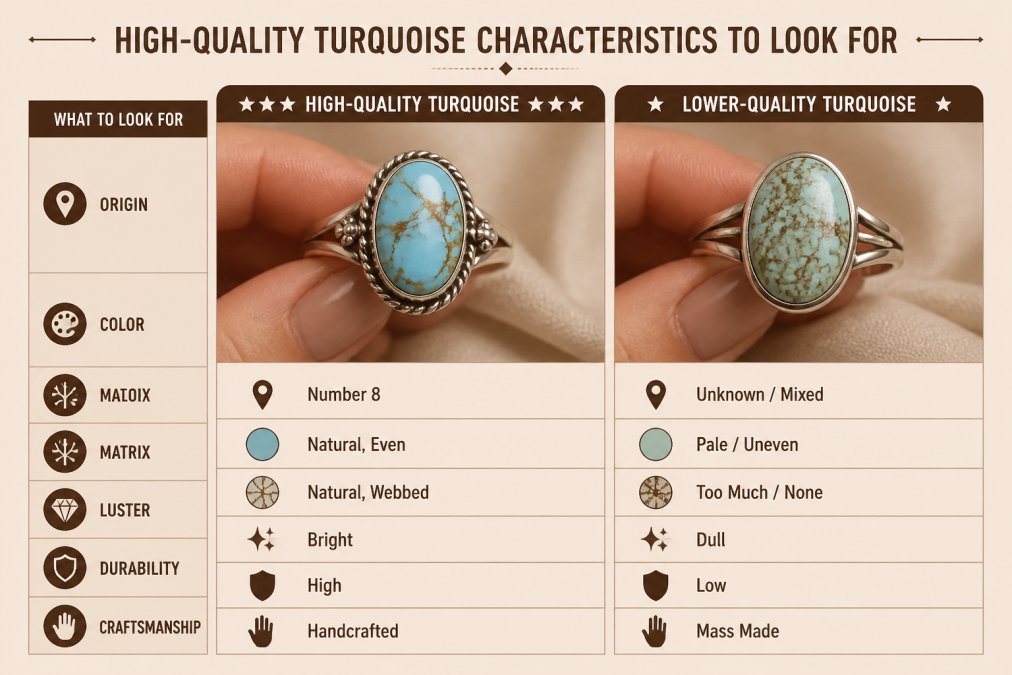
Color, Matrix, and Mine Origin
Color is the first thing graders assess. Deep sky blue and blue-green with strong saturation command the most attention.
Matrix is the web of host rock running through the stone. Natural matrix follows the stone's structure, varies in thickness, and often shows a golden-brown or black pattern.
Mine origin matters because supply is finite.
What most guides miss: a famous mine name on a listing proves nothing. Provenance needs documentation, and few online sellers provide it.
How to Identify Fake Turquoise Before You Buy
Fake turquoise usually fails on three tests: color, weight, and disclosure. Real stone has variation; imitation is too uniform.
Use this checklist before any purchase:
- Ask for the treatment status in writing (natural, stabilized, or dyed)
- Request the mine name and any provenance documentation
- Look for color variation between stones in multi-stone pieces
- Check that matrix patterns differ from stone to stone
- Confirm the metal is stamped sterling, not plated
- Ask whether the piece is one-of-a-kind or a repeated design
- Buy from a seller who answers these questions without pressure
Dyed howlite is the most common imitation. It takes dye well, shows chalky white streaks under close inspection, and feels lighter than real turquoise. A jeweler's loupe makes the difference obvious.
Number Eight Mined Turquoise 4 Large Stones in Sterling Silver. Adjustable →
Turquoise Jewelry Resale Value and the Investment Reality
Turquoise jewelry resale value is almost always below purchase price, the honest answer most sellers avoid.
Here is the gap in the market: no independently verified price history or resale data supports claims of strong investment returns on turquoise.
Compare turquoise to assets with liquid, documented markets. Stocks, bonds, and even gold have public pricing you can verify daily; turquoise does not. Its value depends on finding a buyer who wants that specific stone, mine, and setting.
The Total Cost of Owning Turquoise
Purchase price is only the first number. A piece you keep and insure carries ongoing costs most buying guides never mention.
| Cost category | What it covers | When it applies |
|---|---|---|
| Purchase price | The piece itself | At purchase |
| Appraisal fee | Written valuation for insurance | At purchase or when updating coverage |
| Insurance premium | Annual coverage on scheduled jewelry | Every year you insure it |
| Maintenance | Re-tipping prongs, re-polishing metal, restringing beads | As needed over the piece's life |
| Selling costs | Dealer commission, auction fees, shipping, and authentication if you resell | At sale |
Add those up and the resale math gets harder, not easier. Pay for an appraisal, insure the piece for years, then sell through a dealer who takes a commission, and net proceeds can land well below what you paid even if the stone held its value.
Where Turquoise Does Hold Value
- Collector demand for documented, high-grade American mine stones
- Vintage and antique pieces with verifiable age and maker marks
- Replacement cost, which is what insurance covers, not what you can sell for
A Buyer-Specific Decision Framework
Whether turquoise is "worth it" depends on why you are buying.
If you are buying to wear: Judge the piece on fit, design, and treatment disclosure.
If you are buying to collect: Focus on documented mine origin, natural (untreated) status, and rarity of color and matrix.
If you are buying for heirs: Heirloom value is sentimental and replacement-based, not liquid.
Most buyers land in the first two categories, and that is fine.
Authentication, Appraisal, and Insurance for Turquoise
An appraisal establishes replacement value for insurance, not resale value. Those are different numbers, and confusing them leads to disappointment.
A qualified gemologist or appraiser examines the stone, confirms treatment status, identifies the metal, and documents the piece.
For insurance, you need replacement cost, which is what it would cost to buy a comparable piece today. Keep your purchase receipt, appraisal report, and photographs together.
The evidence behind appreciation claims rarely survives this process.
Verdict: Who Should Buy Authentic Turquoise
Authentic turquoise is worth the investment if you define investment as lasting personal value. It is a poor fit if you expect financial returns.
Buy it if you want a handcrafted piece with real stone, documented treatment status, and a design you will wear for years. Our Number 8 turquoise rings start at $119, each built around genuine Number 8 stones with natural matrix and solid sterling silver.
Skip it if your goal is appreciation, liquidity, or quick resale. Turquoise does not offer those, and any seller who promises them is overselling.
The middle path works for most buyers: choose documented stones from known mines, buy pieces you genuinely love, and treat resale as a bonus rather than a plan.
Frequently Asked Questions
Is genuine turquoise worth anything?
Yes, but value depends on the stone, not the label. Fine natural turquoise is more valuable because it is rare and in demand, according to the Gemological Institute of America. Stabilized turquoise is treated to improve durability and is generally priced lower than similar natural-turquoise jewelry. A natural stone with strong color and desirable matrix from a known mine can carry real value; a dyed howlite imitation carries almost none. The gap between the two is where most buyers get burned.
Does authentic turquoise jewelry hold its value?
Sometimes, but not reliably. There is no independently verified price history or resale data showing consistent returns, and the widely repeated claim of annual appreciation above 30% comes from a jewelry seller without published methodology. Authentic turquoise holds value best when it is natural, high grade, from a recognized mine, and set in solid sterling silver. Treat resale as a bonus, not a plan. Buy because you want to wear it.
Is treated turquoise worth less than untreated turquoise?
Generally yes. Natural, untreated turquoise is presented as more valuable than comparable stabilized turquoise, which is treated to improve durability and typically priced lower. That does not make stabilized stones worthless: they are real turquoise, they resist chipping and fading better, and they cost less. The problem is paying natural-stone prices for a treated stone. Always ask for treatment disclosure in writing before you buy.
How can you check whether turquoise is authentic before buying?
Start with the seller: ask directly whether the turquoise is natural, stabilized, or dyed, and get the answer in writing. Look at the matrix, since real stones show irregular veining that does not repeat, while dyed howlite often shows dark spiderweb lines that look painted on. Check the metal for a sterling stamp. For anything expensive, pay for an independent appraisal from a qualified gemologist before you commit, and confirm the return policy covers authentication disputes.
What makes some turquoise more valuable than other turquoise?
Color, matrix, mine origin, and rarity drive most of the difference. Deep sky-blue with minimal matrix and a recognized mine name, such as Number 8, commands more than pale or heavily webbed material. Supply matters too: when a mine closes, existing stones become scarcer and collector demand pushes prices up. Size and cut count as well, and a natural untreated stone in a handcrafted sterling silver setting will always outvalue a treated stone of the same size.
Buying authentic turquoise should feel confident, not risky. Cactus Rose Jewelry handcrafts one-of-a-kind Southwestern pieces using genuine Number 8 turquoise and solid sterling silver, with adjustable sizing so the fit works as well as the stone. Explore our collection and find a piece you will actually wear, made from materials worth keeping.